


What we will know after reading this blog:-
- What does DNS means (in plain Engilsh)?
- How does it works ?
- Its functioning in the world of internet.
What is DNS?
DNS stands for Domain Name System. A domain is a unique string (xyz.com) associated with an IP address. An IP address is a string of numbers used to identify a computer or resource on a network or internet. The Domain Name System (DNS) is a network of directories on the internet used to resolve host names (e.g. http://www.xyz.com) into machine-readable IP addresses (e.g. 192.168.1.2).
DNS makes our life easier, see how-
Every Device on the internet has a unique name and unique IP address. There are millions of such devices. Computers communicate on the internet using the machine-readable IP addresses. So basically if there was no DNS system then we have to memorise all these ip addresses to communicate with another device on internet.
SOUNDS EASY? lets have a look how these look first, 192.168.1.1 (in IPv4), or more complex newer alphanumeric IP addresses such as 2400:cb00:2048:1::c629:d7a2 (in IPv6).
Now I am quite sure, we all are too thankful to this DNS system.
How DNS works?
The process of DNS resolution involves converting a hostname (such as http://www.example.com) into a computer-friendly IP address (such as 192.168.1.2)
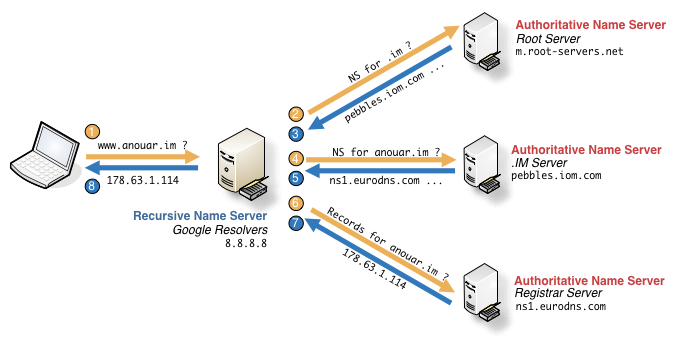
There are 4 DNS servers involved in loading a webpage:
- DNS recursor – The recursor can be thought of as a librarian who is asked to go find a particular book somewhere in a library. The DNS recursor is a server designed to receive queries from client machines through applications such as web browsers. Typically the recursor is then responsible for making additional requests in order to satisfy the client’s DNS query.
- Root nameserver – The root server is the first step in translating (resolving) human readable host names into IP addresses. It can be thought of like an index in a library that points to different racks of books – typically it serves as a reference to other more specific locations.
- TLD nameserver – The top level domain server (TLD) can be thought of as a specific rack of books in a library. This nameserver is the next step in the search for a specific IP address, and it hosts the last portion of a hostname (In example.com, the TLD server is “com”).
- Authoritative nameserver – This final nameserver can be thought of as a dictionary on a rack of books, in which a specific name can be translated into its definition. The authoritative nameserver is the last stop in the nameserver query. If the authoritative name server has access to the requested record, it will return the IP address for the requested hostname back to the DNS Recursor (the librarian) that made the initial request.

 Techno Shab's Blog